Monday, May 23, 2016

Affirmative Action

Alec Pratt
Final Project Web Post
May 23, 2016

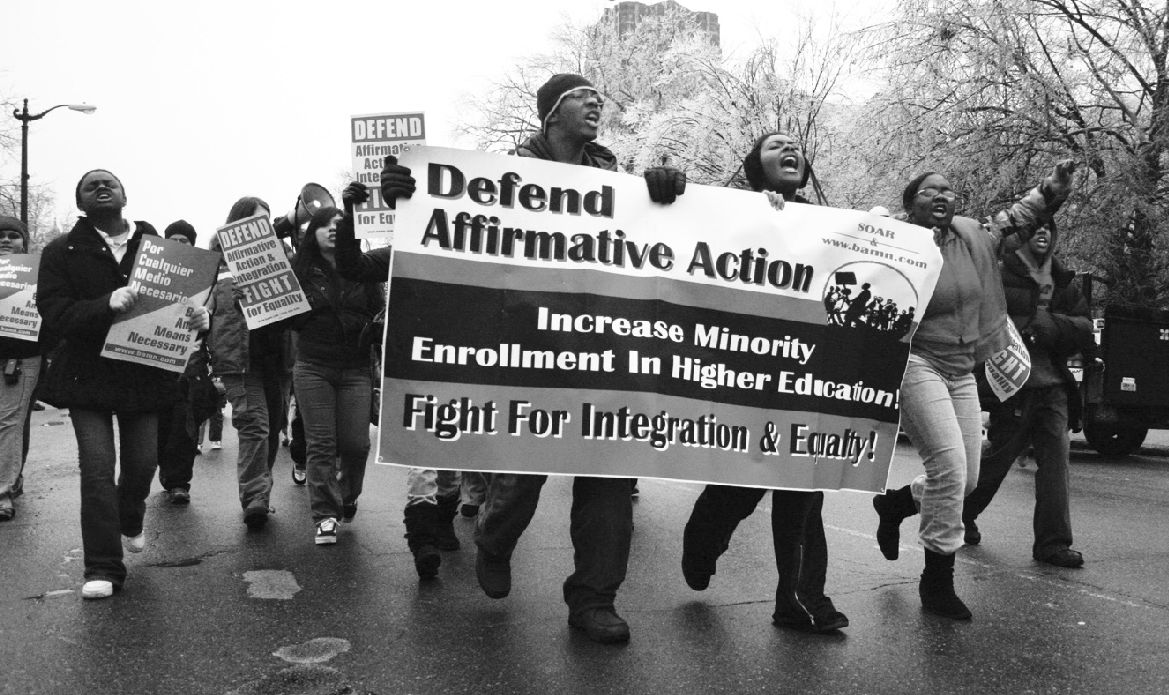
Affirmative Action is the practice of improving the educational and job opportunities of members of groups that have not been treated fairly in the past because of their race, sex, etc. Affirmative action programs have been and can potentially continue to be very beneficial to the society and structure of the United States. Affirmative action programs can be seen in many different places such as the professional business world, college applications, and employment. While Affirmative Action programs have helped benefit those certain things like college applications and acceptance and employment, there are many different places that affirmative action is still required. In the realm of pay, women are payed 77 cents to every white males dollar. Also, in regards to governmental contracting, women owned companies are only given around 2.9% of possible contracts (2002). Still, there are many places where Affirmative Action programs have worked. The amount of women in the professional workforce has increased by massive amounts, and minority acceptance into elite colleges has dramatically increased as well. While the benefits of affirmative action may seem very promising and good for society, there are mixed reviews on the idea of Affirmative Action. Many people are against the idea of Affirmative Action. From ideas ranging from reverse discrimination to affirmative action programs leading to reverse discrimination on groups such as the whites and Asians, the disagreement with the established programs is still there. Some of these views may be justified with the the inequality of application weight that makes certain lower scores look better because of ones race. Affirmative action has and potentially will continue to promote and create racial equality and fairness in the United States of America.

For more information look at the resources provided down below.


Sources:
Merriam Webster Online Dictionary
Wikipedia
Civil Rights Organization 


Sunday, May 1, 2016

Unit 4 Section 4 Judiciary

Alec Pratt
5/1/2016
Unit 4 Section 4 Judiciary

The Republicans' Rash Rejection of Merrick Garland
http://harvardpolitics.com/united-states/the-republicans-rash-rejection-of-merrick-garland/

The death of Justice Antonin Scalia has left a void in the Supreme Court. Unlike other general appointments, the confirmation process for the recent nominee, Merrick Garland, has been halted by the republican party. The Supreme Court has been for many weeks been an eight person court which is very harmful to both parties when it comes to decisions. The republican party though has refused to hear the confirmation process of Merrick Garland. Overall this decision only hurts the republican party in the upcoming election and the SCOTUS.

Sen Mitch McConnell official.jpgThe POTUS, Barrack Obama, is in the dying days of his presidency, but he still has the ability to nominate justices. However, the republican party wants to deny him of making the court a "liberal" court. This decision to not allow the process to occur creates a very poor image of the Republican Party. Many senators that are up for re-election are in danger because they refuse to open up to Merrick Garland. Also, the party looks foolish because they will not allow for the process to take place, even after large members of the party stated that Merrick Garland would be the best person for President Obama to appoint. This also hurts the SCOTUS because now decisions that result in 4-4 will end up going back to the lower courts decision. This is bad because the Federal District Court's decision does not set a national precedent. This relates back to the republican party because now the courts are in a left sided equilibrium so it will be harder for the courts to pass the right's agenda.

Unit 4 Section 3 Bureaucracy

Alec Pratt
5/1/2016
Unit 4 Section 3 Bureaucracy

The Whistleblower Protection Program is Broken Too
Article:
http://www.huffingtonpost.com/scott-d-gerber/whistleblower-protection_b_5510792.html

As of recent, the bureaucracy and many components of the bureaucracy have come under fire from politicians and political thinkers. Many believe that certain departments of the bureaucracy are broken and should be removed or downsized. These thoughts do not avoid the programs brought around by bureaucracy. Recently, the Whistleblower Protection Act has been one of those components under fire. The system was redone in 2011, resulting in a complete overhaul of the previous methods. However, instead of following the new system, many investigators have been found to just want to close the cases instead of follow them correctly. A portion of these whistleblowers coming forward are also being blamed for these problems and according to the article, around 5% of whistleblowers actually receive their reward.


The Whistleblower Protection Act of 1989 protects federal workers from punishment if they come forward with misconduct or errors in the United States Government. This provides incentive for the federal workers to keep the federal bureaucracy not corrupt. However, this article really points out the problems with the new system. Many workers are being treated poorly because of how they come forward, the methods are not followed, and a small percentage of those who come forward receive their merit based reward. The new version of the Whistleblower Protection Act has provided regulations that must be followed; however, these regulations are not being followed. The system is not being followed, and it is broken. Rewards are not being given, and the system is not working. I personally think that the Whistleblower Protection Act needs to be reformed and strictly followed.

Thursday, March 31, 2016

Unit 4 Section 2 Web Post

Alec Pratt
Unit 4 Section 2
3/31/2016

Big News: President Obama Is Headed to Cuba
https://www.whitehouse.gov/blog/2016/02/18/big-news-president-obama-headed-cuba

President Barack Obama planned and went to Cuba March 21st. This trip is monumental to United States diplomacy. President Obama was the first president to visit Cuba since Calvin Coolidge traveled to Cuba in 1928. This venture to Cuba is great for the forward progress between opening back up relations between Cuba and the United States.

President Obama definitly followed his role as Chief Diplomat with this trip to Cuba. He is using his ability as Chief Diplomat to open relations with the foreign country. The president came under a lot of fire from the opposite side of the political spectrum during this trip though. The bombings and attacks of Belgium did not stop the POTUS to continue onto Cuba and later Argentina. This created lots of unwaranted drama between the two major political parties in the USA. By continuing onto cuba, President Obama showed he will not be scared by terrorism. Many good things came out of this trip as well. Meetings with the new president of Argentina proved to be successful and the Tampa Bay Rays beat Cuba. All bad jokes aside, the opening of relations between both Cuba and the United States can be very beneficial for both countries.


Tuesday, March 22, 2016

Unit 4 Section 1 Blog Post

Alec Pratt
March 22, 2016
Unit 4 Section 1

Representative Dan Lipinski

Rep. Lipinski has been a member of Congress since 2005.  Before becoming a member of congress, Rep. Lipinski was an engineer and a college professor. His largest contributor is the Polish American leadership PAC, which gave him around 1800 dollars in 2014. Rep. Lipinski’s district is a part of chicago and is heavily concerned with technology. He has served 6 terms as a representative for Illinois. His major committee assignments include: House committee on Science, Space and Technology, and House committee on Transportation and Infrastructure. He is a ranking member of the subcommittee on Research and Technology.

What Would Dan Do?

H.R. 4528: ENCRYPT Act of 2016

I believe that Rep. Lipinski would vote in favor of the ENCRYPT Act. Coming from a technologically advanced district, and because he sits on many technology based committees, I believe that Rep. Lipinski would vote for the passing of this act. The ENCRYPT Act would prevent states from banning encryption. This would be very beneficial to the furthering of technology without the invasion of the outside. While the act is being sent and is based around terrorism and crime, i believe that Rep. Lipinski understands the need for privacy in technology.

H.R. Aviation Innovation, Reform, and Re-Authorization Act of 2016

I believe that Rep. Lipinski would not vote in favor of the Aviation Innovation, Reform, and Re-Authorization Act of 2016. I believe that Rep. Lipinski would vote for the continuation of the air to be controlled by the FAA instead of privatizing the air. Rep. Lipinski serves on the Aviation subcommittee in the House as well. Coming from Chicago, i think he would see that having all airways under the same one control makes things a lot easier and safer.

H.R. Sentencing Reform Act of 2015

I think that Rep. Lipinski would not vote for the passing of the Sentencing Reform Act. Coming from an urban area, I believe that Rep. Lipinski would want to make his streets safe. While many prisoners may change while they are imprisoned, shortening a drug dealers sentence could lead to more drugs being sold in his district. I think that Rep. Lipinski would want the best for his people by keeping those who need to be in prison, in prison. However, I do believe that some one with the views like Lipinski would not be 100% opposed to changing sentencing and how it is done. I just think he wouldnt agree with certain components of the bill.

Tuesday, March 1, 2016

Unit 3 Blog Post

Alec Pratt
March 1, 2016
Unit 3

Super Tuesday: CNN projects Clinton wins Georgia, Virginia; Sanders takes Vermont
http://www.cnn.com/2016/03/01/politics/super-tuesday-highlights/index.html

As the race for the Oval Office in 2016 continues, candidates are becoming more desperate to win delegates and votes from those through the country. Super Tuesday is one the most important primary days in the election cycle. The recent projections and results from these primaries have gone to show major increase in the delegate counts for both Hillary Clinton and Donald Trump. Other candidates are considered to be getting small, but still very important delegates from these primaries. Candidates like Ted Cruz and Marco Rubio need these delegates if they wish to continue to run and actually have a chance of getting the nomination.

In order to be the nominee for a party, candidates must have a majority of delegates at the their respective national convention. Today, many voters casted their votes for who they wish to be the nominee. Super Tuesday is such a vital component to the presidential race. hile these primaries only give their delegates out proportionally, winning a lot of delegates is major to win the nomination. Republicans need 1237 delegates at the convention in order to win the majority. Donald Trump, the Republican front runner, has still under 100 delegates. Gaining a lot of delegates from these primaries will be monumental for his campaign. In other campaigns, a win in Texas would be critical for the Senator Ted Cruz, and a win in Virginia would be important for Senator Marco Rubio, seeing he has not won a single primary or caucus. In the Democratic side, the recent dominance by Hillary Clinton has started to seperate her from Bernie Sanders. Hillary has been projected to win important states Georgia, Virginia and Texas. Senator Sanders is projected to only have won so far Vermont (These projections are all at the time of this blog being written, and may not be factual.)The media has held low coverage to these primaries and caucuses due to the large influence media has on voting, and how much these votes matter to the nominee process. All results from these primaries and caucuses are very important to the continuation of candidates campaigns. It is predicted that all candidates,excluding Dr. Ben Carson, are to remain in the race even without major wins today.


Monday, February 22, 2016

Unit Two Current Event Post

Alec Pratt
February 22, 2016
Unit Two Current Event

Why Californians Vote Less Than Others
http://www.nbcbayarea.com/blogs/prop-zero/California-Voter-Registration-130791063.html


The turnout of larger states, including those such as Florida, California, and Texas, continually have low voter turn out and civic participation. There are many different things that can affect how and why these rates are so low; however, these large states have terrible participation rates. According to the article,  voter participation is based on social connection. The people of California are not well connected and that is a main factor to why their participation is so low. All three of those large states previously stated have huge impacts in the election of presidents. All three have major electoral college votes and have had huge impacts in the past two election cycles. However, there is still a lack of participation.

Many studies have shown that climate and location has to do with the rate of registered voters in a state. California does not follow these patterns. From the article, a large portion of the lack of voting has to do with a large portion of the population being under 18. This has huge effects on the rate of voters and their participation. There are many other reasons besides those stated in this article that can effect how often and if people vote. Many modern topics are not salient with prospect voters. This can lead to lack of care or want to vote. Also, many people do not communicate and cannot relate within their own demographic. Many different polls have been linked to the research of states and their voting portions. A majority of people need to know that they have the popular sovereignty within this government. People need to get out and vote so that our country may be made better.